
Every choice here
has a reason.
Otto Family Club was built with intention — from the wood on the climbing wall to the programs we run every week. Here's why we made it this way.
Three things in one place: a nature-inspired playground, 8 developmental programs, and a community where parents actually belong.
"Before we designed a single element, Ellen and I spent months studying award-winning playgrounds and reading research on early childhood development. We drew things out, changed our minds, started over. What you see here isn't what we designed first — it's what we kept coming back to, because the research supported it and it felt right for kids."
Why we built this
Three things missing from modern family life
We looked around at what families with young children actually needed — and kept seeing the same three gaps. Otto Family Club was built to fill them.
A Nature-Rooted Space
Screen time for kids under 5 is at an all-time high. We built the opposite: a space made of wood, natural textures, earthy colors, and open-ended exploration — the environment children are wired to learn in.
Everything Under One Roof
Running between the gym, the art class, the music lesson, and the coffee shop is exhausting. We put it all in one place — programs, free play, and a real parent lounge — so your morning doesn't have to be a commute.
A Real Community
Isolation is one of the most common struggles for parents of young children. Otto is designed to be the place you come back to — where you know the staff, your kid knows the other kids, and you actually talk to the adults around you.
A Morning at Otto
This is what everything under one roof actually looks like
Three pillars. One morning. No commute.
The Programs
Drop Leo at Dance & Movement
10am. He's been coming every Friday for two months. He knows his teacher. He runs in without looking back.
The Parent Lounge
Get a coffee. Actually sit down.
The lounge has WiFi, snacks, and — rare in parenting — other adults to talk to. You're not waiting in a hallway. You're somewhere worth being.
The Playground
Class ends. Free play begins.
Leo heads straight for the climbing wall. You can see him from the lounge. Another parent joins you. You'll both be back next week.
"We wanted parents to feel like they got something out of the morning too — not just the kids. That's what makes people come back."
The science behind it all
Why ages 0–5 matter more than any other window
We didn't pick this age range randomly. The first five years are the most critical period of brain development in a human's entire life — and the most underserved by quality enrichment programs.
1M+
Neural connections formed per second in the first years of life
Zero to Three Foundation
90%
Of critical brain development is complete by age 5
Chalkbeat / Dr. Alissa Huth-Bocks, 2025
2×
The brain nearly doubles in size during the first year alone
National Institute of Mental Health
The foundations built before kindergarten — how a child regulates emotions, connects with others, solves problems, and approaches learning — are the hardest to rebuild later. We take that window seriously.
The Playground
We didn't buy a playground.
We designed one.
Every element was chosen because research shows it benefits developing minds and bodies. Here's what we built and why each piece matters.
Stacy & Ellen personally reviewed hundreds of playground designs and research studies before finalizing each element below.
Vestibular + Proprioceptive System
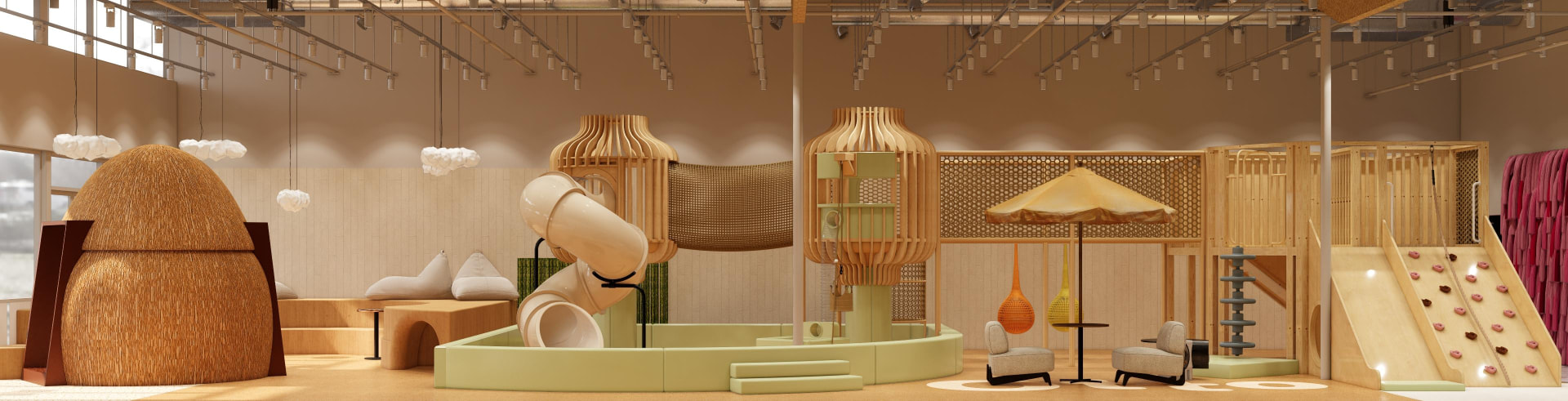
The net bridge trains the senses you can't see
The net bridge connecting the climbing towers looks like a fun crossing — and it is. But it's also one of the most powerful sensory tools in the space. Every step on an unstable surface challenges a child's vestibular system (balance) and proprioceptive system (body awareness), two foundational sensory systems that affect everything from attention span to handwriting readiness.
Children who get regular practice on unstable surfaces tend to have better coordination, better focus, and greater emotional regulation — because the same brain regions that handle balance also handle self-control.
Physical + Cognitive Development
The climbing wall builds brains, not just muscles
That's problem-solving, sequencing, and spatial reasoning — all wrapped in something that just looks like fun.
Our low-height rock wall features varied hold shapes and colors so children at every ability level can participate — from an 18-month-old stepping up one foot to a 4-year-old navigating a full route.
Sensory Processing + Emotional Regulation
The tunnel slide is a sensory processing masterclass
The enclosed curved tunnel slide simultaneously challenges the vestibular system (spinning, descending), the proprioceptive system (tight enclosure, pressure), and the visual system (darkness to light), all in a few seconds.
Children who encounter mild, controlled sensory challenges in a safe environment build stronger sensory processing systems — which is linked to calmer, more regulated behavior in the rest of the day. This is why occupational therapists regularly recommend tunnel and enclosed slide play for children who struggle with transitions.
Self-Regulation + Imaginative Play
The nest gives children a space to be small
The woven straw nest pod — modeled after a bird's nest — is an important element in the space. Young children need enclosed, cozy spaces to retreat to when they're overstimulated. These "den" or "cave" environments activate the parasympathetic nervous system and help children self-regulate.
Inside the nest, children also engage in the richest form of imaginative play — dramatic play, story-making, social negotiation with peers. Pediatric psychologists call these experiences the foundation of language development, emotional intelligence, and executive function.
Tactile Development + Biophilia
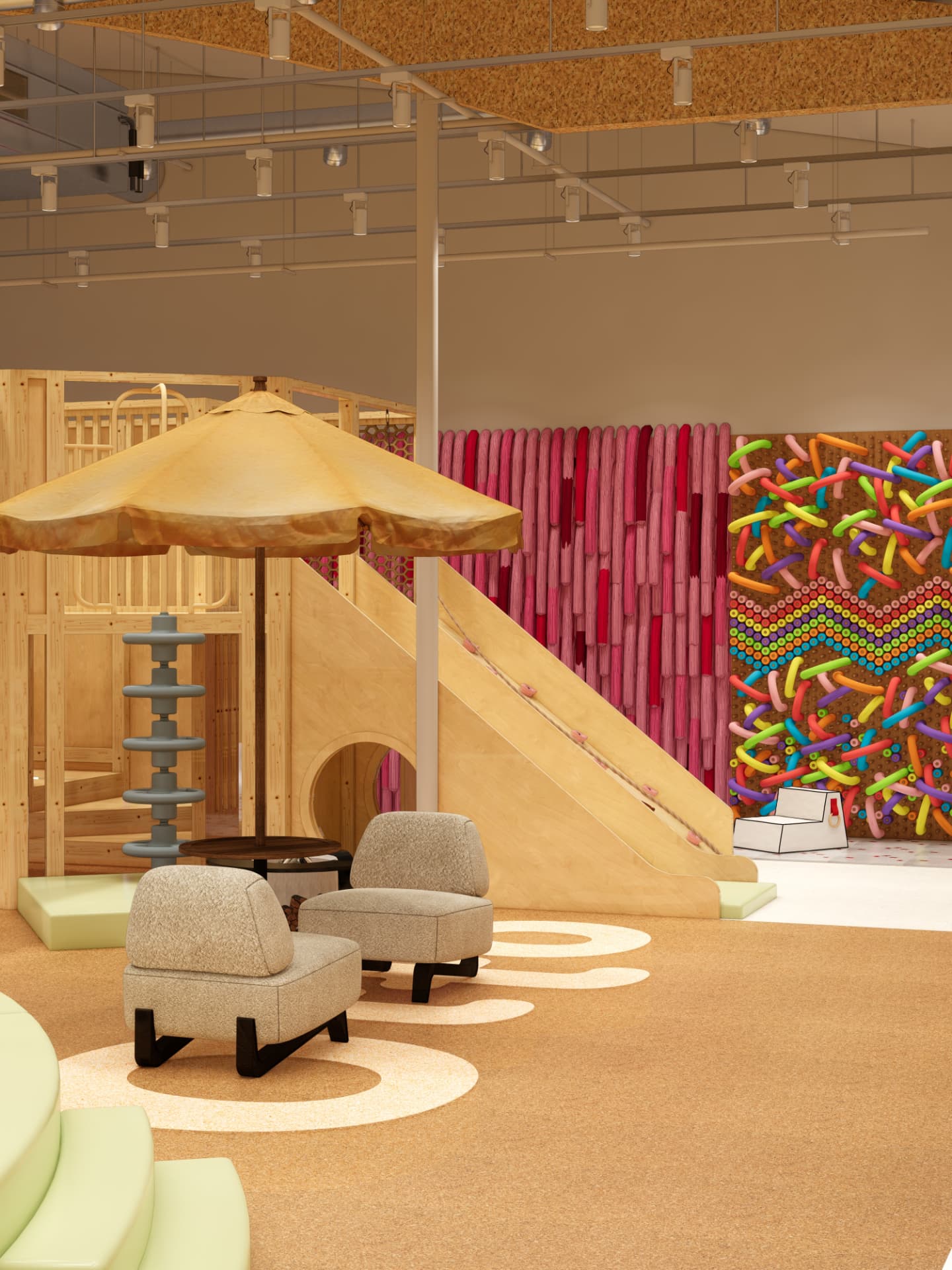
Real wood, real textures!
This is a deliberate choice rooted in research on biophilic design: humans, especially young children, respond differently to natural materials than to synthetic ones.
Natural wood has varied grain, warmth, and texture that engages a child's tactile system in ways that plastic cannot. It also wears differently, sounds different, and smells different — engaging more senses and encouraging longer, more engaged play. Studies from the University of Tennessee and University of British Columbia both found that children in nature-inspired play environments demonstrated more creative, sustained, and social play than those in conventional plastic playgrounds.
Dark Green
Warm Sand
Sage
Clay
Cognitive Environment + Calm Focus
The colors are quiet on purpose
This is the opposite of the primary-color saturation you see in most children's spaces, and it's intentional.
Research in environmental psychology shows that high-stimulation color environments (bright primary colors on every surface) actually increase cortisol levels in young children and make it harder to focus. Nature-inspired, lower-saturation environments reduce visual noise, lower stress responses, and allow children to sustain attention longer — which means better learning and more creative, imaginative play. The pops of color in our pillows and soft elements are deliberate — they provide visual interest without overwhelming.
The Programs
8 programs. One big idea:
develop the whole child.
Every program at Otto was chosen because it addresses a specific developmental domain in the 0–5 window. Together they form a complete picture — body, mind, creativity, and connection.
Music & Rhythm
Ages 0–5
Rhythm, singing, and movement develop phonological awareness — the same skill that predicts reading success. Music also activates more regions of the brain simultaneously than any other activity.
Supports language development, pre-literacy, and emotional expression
Creative Arts
Ages 2–5
Open-ended art — painting, sculpting, collage — builds fine motor skills and visual-spatial reasoning while encouraging the kind of experimental, process-over-outcome thinking that drives later innovation.
Supports fine motor skills, creativity, and executive function
Dance & Movement
Ages 18 months–5
Tumbling, balancing, and structured movement develop gross motor skills and body coordination. Dance and movement also teach children to listen to instructions in a structured setting — a key school-readiness skill.
Supports gross motor development, body awareness, and focus
Preschool Ready
Ages 3–5
School readiness is built long before kindergarten: following routines, taking turns, separating from a caregiver, and approaching new tasks with confidence. Preschool Ready practices all of it through stories, early literacy and numeracy games, and small-group projects.
Supports school readiness, independence, and confidence
Sensory Play
Ages 0–3
Sensory play — water, sand, dough, texture — is how infants and toddlers make sense of the world. It's also the foundation of scientific thinking: explore, observe, predict, repeat.
Supports sensory integration, cognitive development, and curiosity
Yoga & Mindfulness
Ages 2–5
Child yoga teaches body awareness, breathing, and self-calming — foundational tools for emotional regulation. Children who learn to notice and manage their bodies show significantly lower anxiety levels throughout school.
Supports emotional regulation, body awareness, and focus
Discovery Lab
Ages 3–5
Hands-on science experiments build the scientific method — hypothesis, experiment, observation — long before a child can read. Curiosity, critical thinking, and problem-solving skills start here.
Supports critical thinking, STEM foundations, and curiosity
Baby & Me
Ages 0–18 months
The earliest program at Otto is for parent and baby together. Attachment, "serve and return" interactions, and early social-emotional development happen most powerfully in caregiver-led experiences in the first 18 months.
Supports secure attachment, early social development, and parent community
The Bigger Picture
We're not just a play space.
We're a village.
The Parent Lounge
While your child plays, you get a moment too.
Most kids' programs treat parents as bystanders — a waiting area with folding chairs and bad lighting. We built something different.
The Otto parent lounge is a real space: good coffee, comfortable seating, fast WiFi, and the kind of low-pressure social environment where you might actually end up talking to the person next to you. Some parents use the time to work. Some use it to rest. Most end up with a friend.
Isolation is one of the most commonly cited struggles for parents of young children. We took that seriously when we designed the space.
Coffee & snacks
Real espresso drinks, not a vending machine. Snacks for kids and adults both.
Fast WiFi & work-friendly seating
Tables and power if you need to get 45 minutes of work done. Soft seating if you just need to sit.
A community, not a waiting room
The same faces, every week. Over time, that becomes something. We've watched it happen.
Visible from the play space
You can see the playground from the lounge. You're close, not absent. Kids feel that.
Your child's first five years deserve the best environment you can give them.
Otto Family Club opens in Sunnyvale in February 2027. Founding member spots are available now — and they come with our full satisfaction guarantee.
Become a Founding Member